Veterans Legacy Project
intro to go here
intro to go here
intro to go here

intro to go here
intro to go here
intro to go here
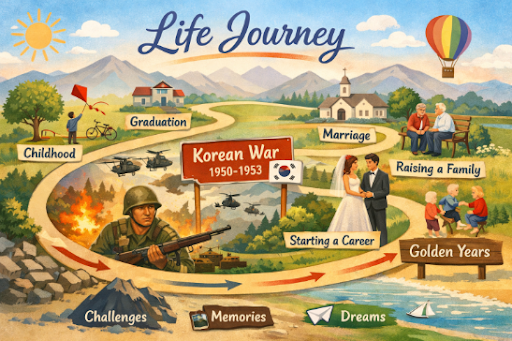
This module provides students with foundational research tools and methods to explore the life story of a Korean War veteran. It is used as part of the instructional design for multiple subsequent modules of this curriculum. Depending on the instructional needs of the teacher or the particular module, this module provides three different research pathways. Additionally, the module provides a structure for students to record their research so that they may synthesize the information they have gathered in the research to craft biographical narratives to submit as entries for the Veterans Legacy Memorial (VLM) of the Veterans Administration.

This module asks students to explore the Courts of the Missing from the National Memorial Cemetery of the Pacific (“Punchbowl Cemetery”), the Work of the Defense POW/MIA Accounting Agency (DPAA), and then research Korean War service members memorialized in the Courts of the Missing who have been identified by the DPAA so that their stories are included as part of the Veterans Legacy Memorial (VLM).
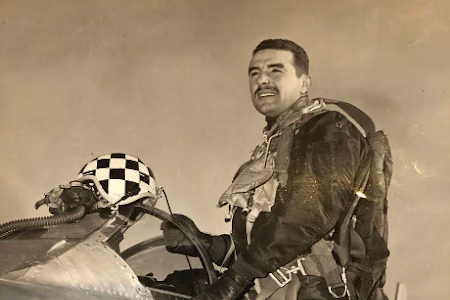
In this lesson, students will study the Korean War by connecting personal stories of veterans to the historical causes and impact of the war. They will examine primary and secondary sources that will help them indicate the causes of the war and link Henry “Hank” Buttelmann's experience during the war to humanize the conflict. Students will work on the hometown hero assignment, where they will research a local veteran, creating a digital wall or one-pager to connect the Korean War to their local community.

This lesson is designed to help students understand the chronology and turning points of the Korean War. Students will analyze different documents for details and historical references to determine their placement on a timeline of the war. After students complete a gallery walk for peer comparison, an accurate timeline of the war will be shared. Finally, students will place their hometown veteran’s story on the Korean War timeline. This process reinforces critical thinking, evidence-based reasoning, and an understanding of historical sequence.
Students will build an understanding of the development of national cemeteries and the dynamic interplay between honoring the individual and honoring the imagined community (or the collective entity to which the individual belongs) through analysis of primary and secondary sources. Students will use this understanding to analyze elements of cemetery design to evaluate the fidelity to which a national cemetery honors the collective sacrifice of an imagined community.

Students will develop an understanding of the purpose and design criteria of a cemetery memorial or monument by analyzing examples from multiple national cemeteries to determine the common design features and components. Students will then demonstrate this understanding by researching a local veteran interred in a national cemetery and creating a monument or memorial that honors both his/her individual service and his/her contribution to the collective imagined community. NOTE: this is best done after Module 5 to understand the concept of individual and collective memorialization.
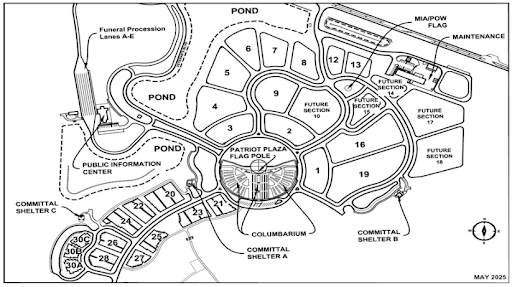
In this lesson, students complete a visual analysis to identify common features of national cemeteries and draw conclusions about the importance of natural and human-made features. Students draw conclusions about their analysis and explain how national cemeteries are a visual poem that is drawn onto the land. As an optional extension, students may use the VLM database to explore the location of specific veteran’s burial sites.
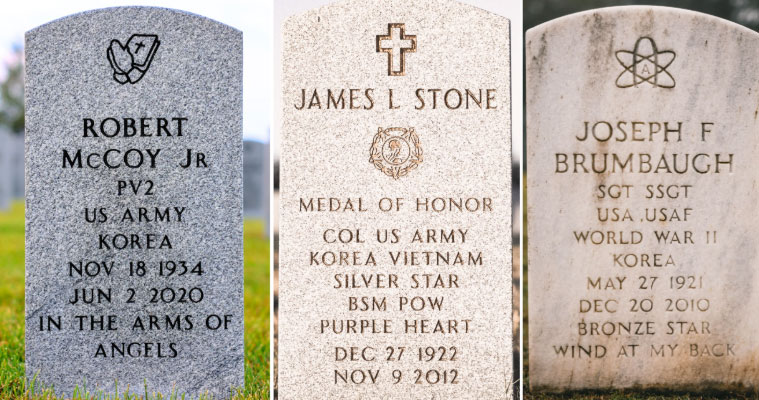
This lesson engages students in a multi-step investigation that begins with analyzing headstones as historical and geographic artifacts and progresses toward identifying demographic patterns among Korean War veterans. Students work in pairs to examine individual veterans, compare cemetery-level and national-level data, and identify similarities and differences in age, emblem of belief, gender, and marital status. Through structured collaboration and guided comparison, students connect individual stories to broader demographic trends and geographic patterns illustrated in burial statistics across national cemeteries.
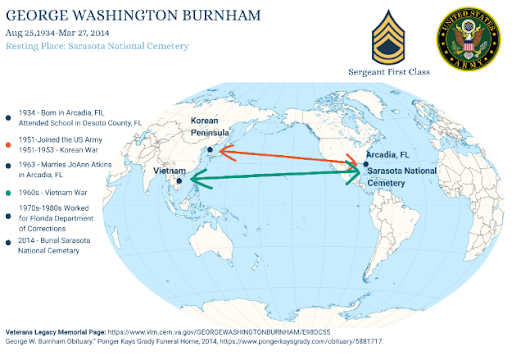
In this lesson, students explore short video clips from U.S. and Korean perspectives to identify examples of cultural diffusion during the Korean War. Building on this, students select a Korean War veteran, research their life using the Veterans Legacy Memorial and other sources, and create a geographic biography that maps key locations and life events before, during, and after the war. Finally, students use their maps, timelines, and research to participate in a structured discussion explaining how Korean and American cultural attributes were or could have been shared through the movements and experiences of these veterans.
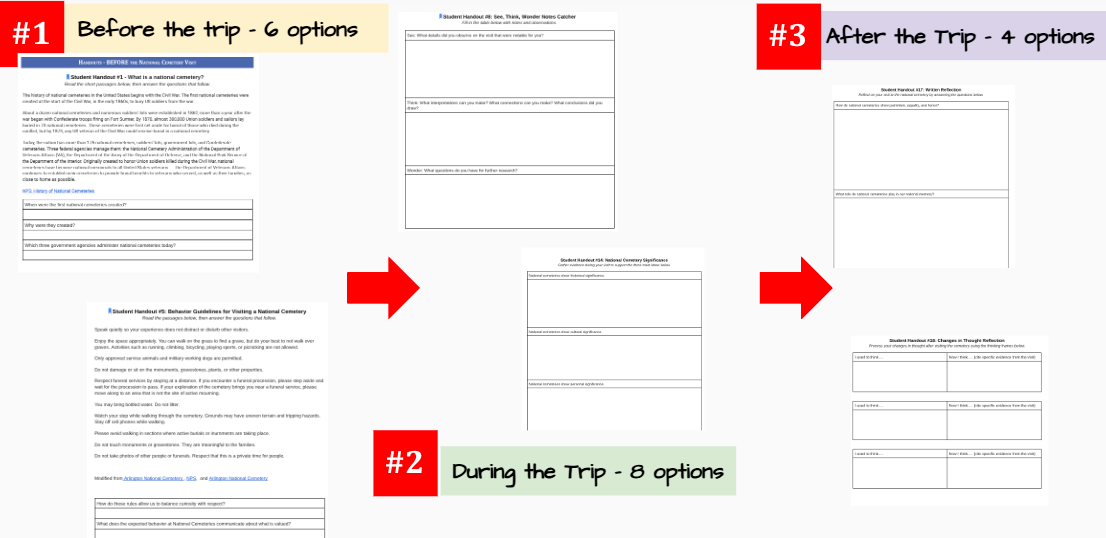
In this module, resources are provided to guide the student learning surrounding a visit to a national cemetery. Resources are bundled in three sections: Preparing for the visit to the national cemetery, Visiting the national cemetery, and Reflections on the visit to the national cemetery. The activities are presented as a menu of options so teachers can choose the activities that align best to their learning goals and the needs of their students. Teachers may choose to do any number of activities from each section, or offer students the choice of different activities.
This project was made possible through the generous support of the Ministry of Patriots and Veterans Affairs
