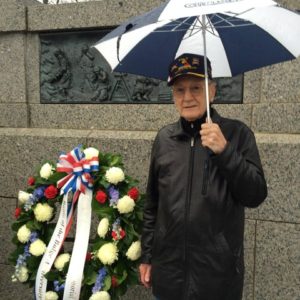
Harry F. Miller
This content was supplied by family and/or community members
Bio

Harry F. Miller was born in Ohio, one of six children in a family that would face formidable challenges. He spent his early years during the hardships of the Great Depression, losing his mother at age three and watching his father struggle with unemployment. Even as a child, Harry shouldered responsibility, delivering newspapers to help support his family. Inspired by watching local World War I veterans march in parades, Harry dreamed of serving his country. At just 15 years old, he demonstrated remarkable determination by joining the Enlisted Reserve Corps, claiming he was 18. When he applied for active duty, he was sent to Ft. Knox, Kentucky, for Basic Training, and then to Ft. Ord, California, where he became part of an amphibious tank unit.
During World War II, Harry served with distinction as a tank crewman in the 740th Tank Battalion. On October 29, 1944, his battalion departed Weymouth, England, arriving at Utah Beach the following evening. The unit was then dispatched to Belgium in preparation for the Battle of the Bulge, only to find chaos: most personnel had fled, dead lay unburied, and equipment was in disrepair. Demonstrating remarkable ingenuity and resolve, Harry and his fellow soldiers restored three M4 Sherman tanks and an M-36 Tank Destroyer, then advanced to Stoumont, Belgium, to confront German forces. The battalion went on to cross the Siegfried Line and played a critical role in capturing the southern side of Cologne. Their final wartime assignment was the occupation of a castle on Lake Schwerin. After the 740th was deactivated, Harry continued his service with the 39th Infantry Regiment at Bad Tolz, Germany, working in the Regimental Message Center, and later with HQ Troop, 2nd Constabulary Regiment at Freising in the message center.
With the outbreak of the Korean War, Harry was entrusted to lead General MacArthur’s alert team, traveling ahead of the general to the Korean battlefront in preparation for each visit. Returning stateside, he served with the Army Security Agency in Arlington, Virginia, before another assignment took him to Germany with a communications intercept unit. Despite his desire to return to Korea, Harry was denied due to his critical security clearance, his expertise deemed too valuable to risk in enemy hands.
After a decade of distinguished Army service, Harry transitioned to the Air Force, entering at the rank of Technical Sergeant. He was stationed at Stewart AFB, New York, served in Alaska, returned to Stewart, and later joined U.S. Air Forces Europe. Eventually, he was assigned to Strategic Air Command Headquarters at Offutt AFB, Nebraska, where his security clearances allowed him to contribute to critical aircraft accident investigations involving lost codes and cipher equipment. During the Cuban Missile Crisis, Harry was placed on war status, working grueling 12- to 24-hour shifts. As the Vietnam War began, he played a key role in planning B-52 strikes, utilizing specialized codes required for the conflict. Harry concluded his military career in 1966, retiring with the esteemed rank of Senior Master Sergeant (SMSgt E8), a testament to his leadership and dedication.
Following his military retirement, Harry continued to serve and protect in civilian life. He became a private investigator, then took on the role of Director of Security and Safety for St. Vincent Hospital in Santa Fe, New Mexico. Later, he joined the University of Texas at Arlington as a Safety Inspector, dedicating 15 years to ensuring the well-being of others before his final retirement.
Photos